Keto vs Paleo: Which Diet Is Right for You?
Keto vs paleo compared: how each diet defines food, carb levels, what you can eat, and how to choose the right one for your goals.

Editorial Team · April 20, 2026 · 6 min read
Last updated May 29, 2026
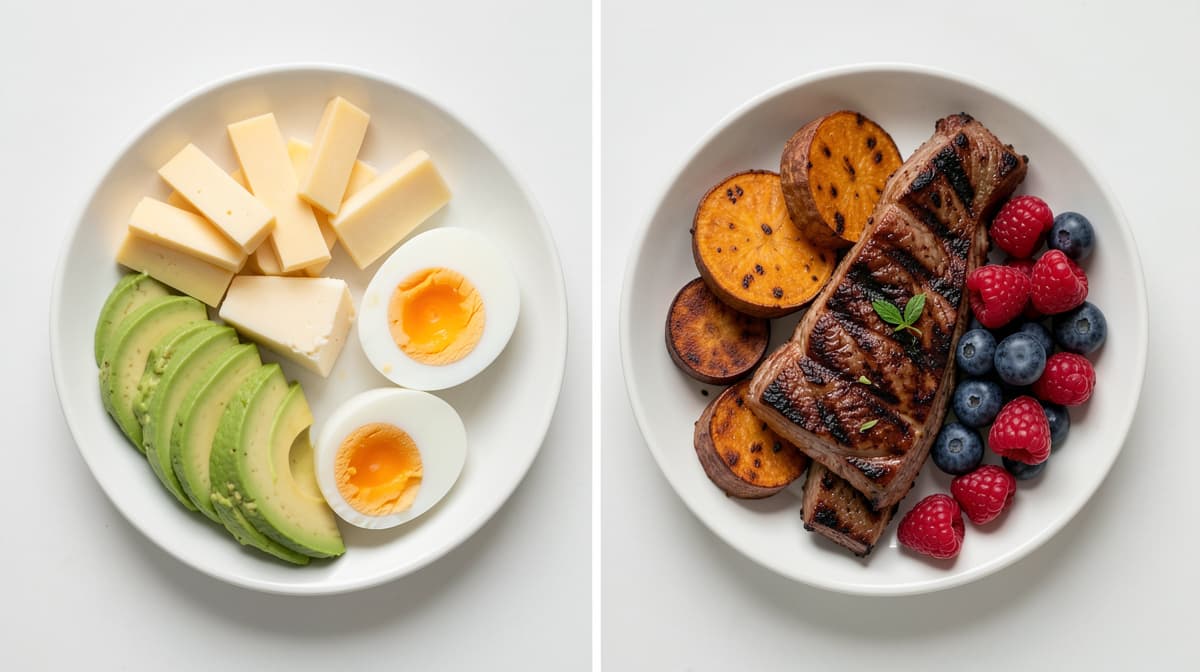
Keto and paleo solve different problems. Keto is defined by macros: very low carb and high fat to reach ketosis, and it allows dairy and processed-but-low-carb foods. Paleo is defined by food quality: whole foods our ancestors ate, with no grains, legumes, dairy, or refined sugar — and it isn't necessarily low-carb, since fruit, honey, and sweet potato are all welcome.
That single distinction — macros versus food quality — explains almost every other difference between the two. Here's how they compare and how to pick.
Keto vs paleo at a glance
| Feature | Keto | Paleo |
|---|---|---|
| Carb level | Very low (usually under 20–50g net carbs/day) | Moderate to high; not restricted |
| Dairy | Allowed (cheese, cream, butter) | Not allowed |
| Grains & legumes | Not allowed | Not allowed |
| Fruit | Limited (mostly berries) | Allowed, including high-sugar fruit |
| Sweeteners | Low-carb sweeteners (erythritol, monk fruit) | Natural sugars (honey, maple) in moderation |
| Primary goal | Reach ketosis via macros | Eat whole, unprocessed foods |
| Best for | Blood sugar, appetite control, steady fat loss | Flexible whole-foods eating, cutting processed food |
What is keto?
The ketogenic diet is a macro-driven way of eating. You keep carbohydrates very low — typically under 20–50g of net carbs per day — keep protein moderate, and raise fat high enough to stay satisfied. The goal is ketosis, a metabolic state where your body burns fat for fuel instead of glucose.
Because keto is defined by numbers, the quality of a food matters less than its macros. A hard cheese, a spoonful of heavy cream, or a packaged low-carb bar can all fit, as long as the carbs stay in budget. That flexibility is keto's strength and its trap: it's easy to hit your macros and still eat poorly if you lean on processed products.
This is exactly why tracking matters more on keto than on most diets. A few hidden grams of carbs — in a sauce, a "keto" snack, or a larger-than-expected portion — can quietly push you out of ketosis. Logging meals in CarbMeNot shows your net carbs in real time, so you know where you stand before the day is over. For a deeper look at what counts, see keto vs low carb, and for a shopping-ready list, the keto food list.
What is paleo?
The paleo diet is a food-quality approach. The rule isn't a carb number — it's a question: would our pre-agricultural ancestors have eaten this? If yes, it's in. If it arrived with farming or industry, it's out.
That means paleo includes meat, fish, eggs, vegetables, fruit, nuts, seeds, and natural fats. It excludes grains, legumes (beans, peanuts, soy), dairy, refined sugar, and most processed foods. Notably, paleo allows fruit, honey, maple syrup, and starchy vegetables like sweet potato — so it can be moderate or even fairly high in carbohydrates depending on your choices.
Paleo's strength is simplicity: there's nothing to count. You eat real, whole foods and skip the processed aisle. The trade-off is that it gives you no direct control over blood sugar or ketosis, because a paleo plate built around fruit and sweet potato can still carry plenty of carbs.
Keto vs paleo: key differences
The two diets overlap more than people expect — both cut grains, legumes, refined sugar, and processed junk. But three differences set them apart:
- Carbs. Keto restricts them tightly; paleo doesn't restrict them at all. This is the biggest practical gap. If your goal depends on a specific carb target, keto enforces it and paleo doesn't.
- Dairy. Keto leans on dairy for fat and convenience (cheese, cream, butter). Paleo excludes all dairy. If you love Greek yogurt or cheese, that's a meaningful difference.
- Processing. Keto judges a food by its macros, so a low-carb processed product can qualify. Paleo judges a food by its origin, so even a zero-carb processed item may be off-limits.
Fruit makes the contrast concrete. On paleo, a banana or a bowl of grapes is perfectly fine. On keto, most fruit is too high in sugar, and you stick to lower-carb options — see keto-friendly fruits for which ones actually fit.
Can you combine keto and paleo?
Yes — and many people do. The "keto-paleo" hybrid keeps carbs low enough for ketosis and limits you to paleo-approved whole foods. In practice you drop two things from standard keto: dairy and processed low-carb products. What's left is meat, fish, eggs, low-carb vegetables, avocados, nuts, seeds, and natural fats like olive oil and coconut oil.
It's the strictest of the three, but also the cleanest. You get the metabolic control of keto with the food quality of paleo. The catch is that removing dairy takes away some of keto's easiest fat sources, so you have to plan a little more deliberately. Tracking with CarbMeNot helps here too, since you're hitting a carb target without leaning on dairy or packaged shortcuts to get there.
Which should you choose?
Match the diet to what you're actually trying to do:
- Choose keto if your goal is blood sugar control, strong appetite suppression, or steady fat loss, and you're willing to track carbs. The macro focus is the point — it gives you a lever paleo doesn't.
- Choose paleo if you want a flexible, whole-foods diet without counting anything, and you're cutting processed food rather than chasing a specific carb number. It's easier to live with long-term for many people.
- Choose keto-paleo if you want both: ketosis-level carb control and a strict whole-foods standard, and you don't mind the extra planning.
The honest answer is that the best diet is the one you'll actually keep doing. Both keto and paleo work when followed consistently, and both fail when they don't fit your life. Start with the one whose core idea — a carb number or a food standard — feels most natural to you.
Make either diet easier to track
Keto lives and dies by your carb count, and even paleo benefits from knowing what's on your plate. CarbMeNot uses AI to log meals from a photo or a quick description, then shows net carbs, fat, and protein instantly — so you can stay in ketosis on keto, keep portions honest on paleo, or hit both standards on keto-paleo without doing math at every meal.
Key takeaways
- Keto is defined by macros (very low carb, high fat); paleo is defined by food quality (whole, ancestral foods).
- Paleo is not automatically low-carb — it allows fruit, honey, and sweet potato.
- Both cut grains, legumes, refined sugar, and processed junk; they differ most on carbs, dairy, and processing.
- You can combine them as keto-paleo for low carbs plus strict whole foods.
- Pick keto for blood-sugar and macro control, paleo for flexible whole-foods eating — and choose the one you can sustain.
Frequently asked questions
- What is the difference between keto and paleo?
- Keto is defined by macros — very low carb and high fat to reach ketosis — and allows dairy and processed-but-low-carb foods. Paleo is defined by food quality — whole foods our ancestors ate — and bans grains, legumes, dairy, and refined sugar, but isn't necessarily low-carb.
- Can you do keto and paleo together?
- Yes. A 'keto-paleo' approach keeps carbs low enough for ketosis while only eating paleo-approved whole foods. You drop dairy and processed keto products and lean on meat, fish, eggs, low-carb vegetables, and healthy fats.
- Which is better, keto or paleo?
- Neither is universally better. Keto tends to suit people focused on blood sugar, appetite control, and steady fat loss through macros. Paleo suits people who want a flexible whole-foods diet without counting carbs. The best one is the one you can sustain.
- Is paleo lower carb than keto?
- No. Keto is much lower in carbs. Paleo allows fruit, honey, and sweet potatoes, so it can be moderate or even high in carbs depending on your choices, while keto deliberately keeps net carbs very low to maintain ketosis.
Sources
Keep reading
Free tools: Is It Keto? checker · macro calculator · protein calculator · 7-day meal plan PDF